
OHS
Standardize OHS management and reduce risks in your operation
Centralize inspections, risks, PPE, and evidence to comply with regulatory safety standards, prevent accidents, and increase team safety.

More than 2,300 companies already use Checklist Fácil



















Strengthen OHS management and reduce risks in your operation
Standardize inspections, centralize evidence, and track risks, corrective actions, and regulatory requirements in a single system.
PREVENTION AND CONTROL
Identify risks before they become incidents
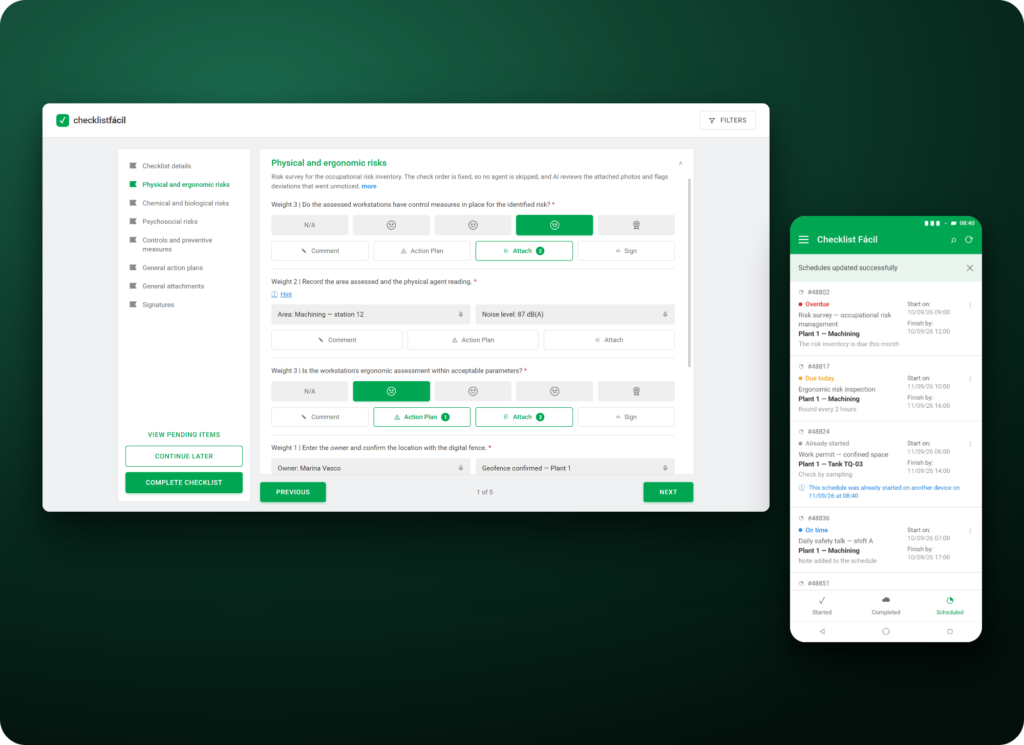
- Use checklist templates to identify occupational risks and support your risk management program (GRO)
- Standardize assessments of physical, chemical, biological, ergonomic, and psychosocial risks
- Set a checking order to ensure inspections are carried out correctly
- Use Artificial Intelligence to help identify nonconformities in images
- Track risks, controls, and deadlines in dashboards integrated with your OHS management
REGULATORY STANDARDS AND LEGAL REQUIREMENTS
Keep your operation aligned with regulatory safety standards
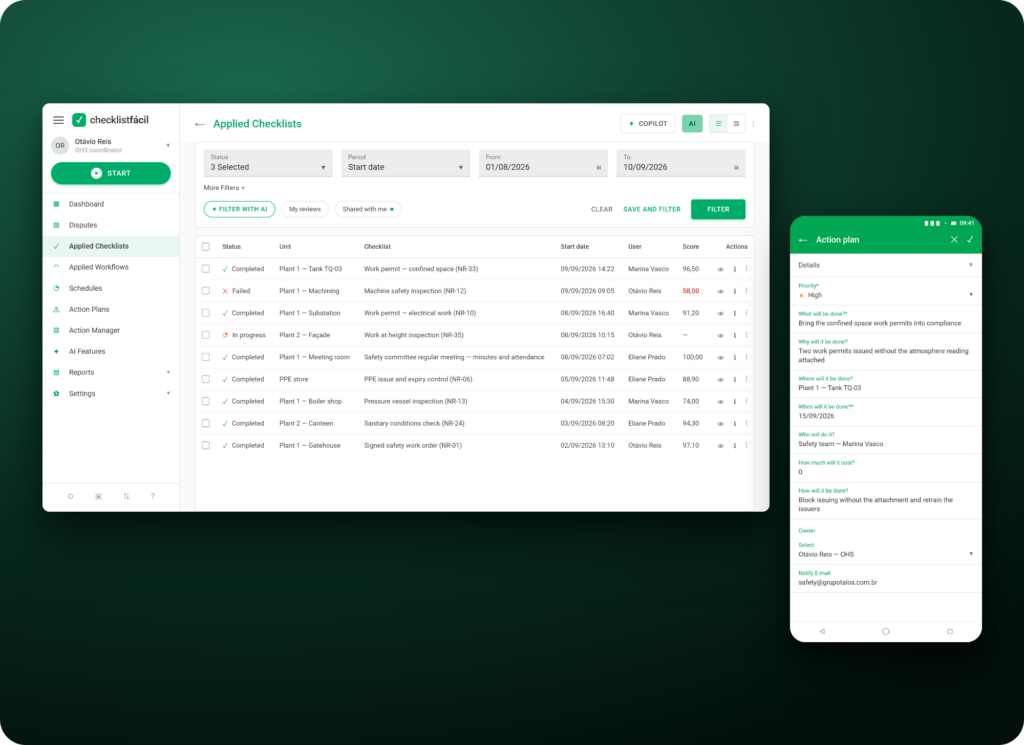
- Centralize checks related to regulatory safety standards in a single system
- Use structured templates for Work Permits, the Internal Accident Prevention Committee (CIPA), and other OHS processes
- Log evidence and history to make audits and inspections easier
- Track nonconformities and create corrective actions with owners and deadlines
- Keep records up to date to reduce the risk of fines, citations, and labor liabilities
CONTROL AND TRACEABILITY
Gain more control over PPE and safety routines
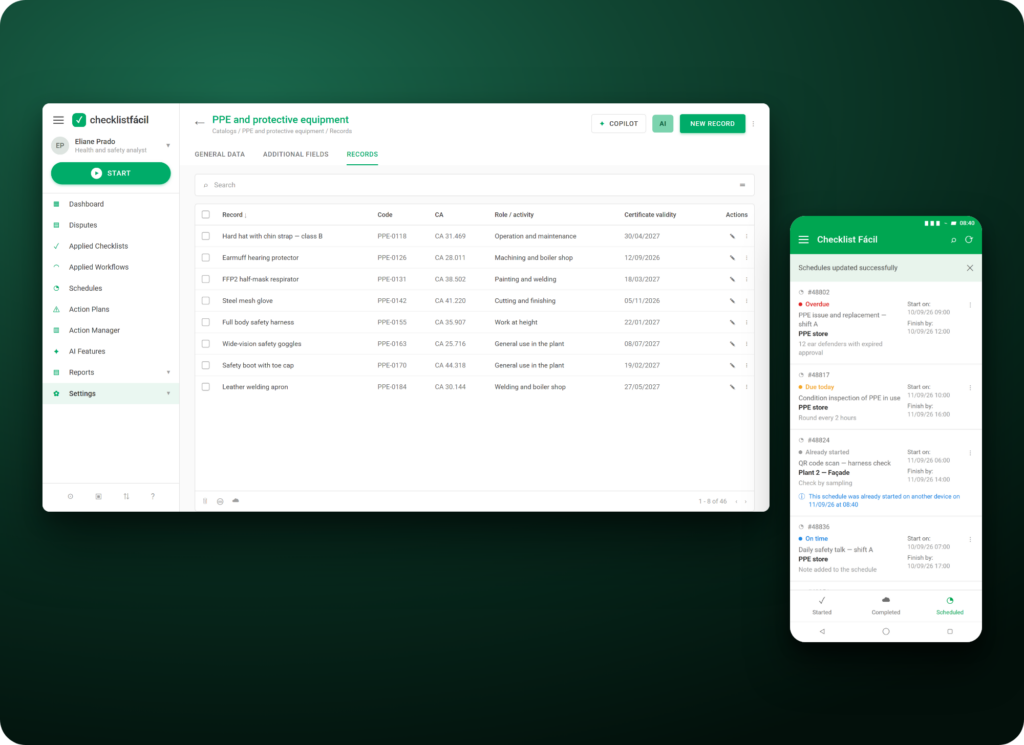
- Control PPE stock, delivery, and use by employee, role, and activity
- Track the expiration and condition of protective equipment
- Use QR Codes and Barcodes to speed up inspections and records
- Centralize training records and Daily Safety Talks
- Log inspection evidence to increase the reliability of information
DATA AND PREVENTIVE ACTIONS
Turn OHS data into faster decisions
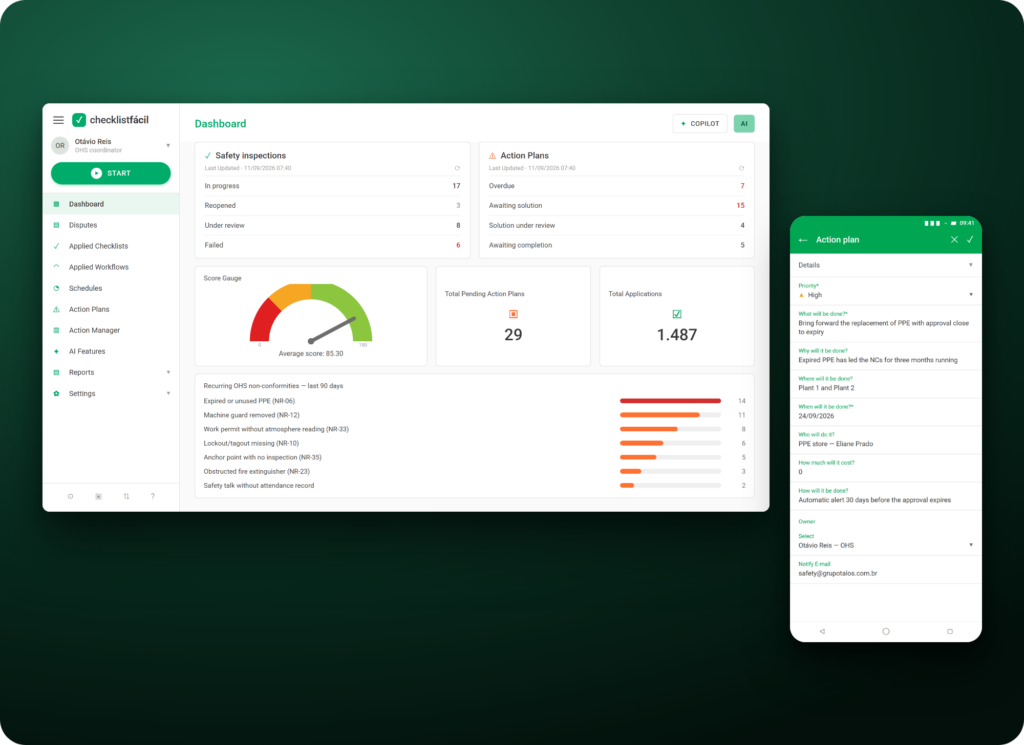
- Track indicators and recurring nonconformities in real time
- Use IoT Sensors to continuously monitor equipment and environments
- Receive automatic alerts when parameters fall outside expected limits
- Integrate data with BI, ERP, and other operational tools
- Create Action Plans to address deviations before they turn into accidents
Overcome the main challenges of OHS management
Centralize data, automate inspections, and track risks to increase team safety and keep your operation compliant.
Non-compliance with regulatory standards
Standardize inspections and keep evidence up to date to make audits and inspections easier.
Inspections without traceability
Centralize records, history, and evidence to prove every action taken.
Inconsistent risk assessments
Use consistent criteria to identify and track occupational risks.
Rework for OHS teams
Digitize manual tasks to free up more time for analysis and preventive actions.
Untreated nonconformities
Create Action Plans with owners and deadlines to quickly correct deviations.
PPE management failures
Control the stock, delivery, expiration, and use of protective equipment.
Low visibility into indicators
Track risks, controls, deadlines, and recurrences in centralized dashboards.
Slow response to risk situations
Receive alerts and log incidents in real time to speed up corrective measures.
START NOW
Turn processes into results starting today
Join over 2,300 companies using AI-powered Operational Intelligence to drive more strategic results
Chosen by more than 2,300 companies
Companies across different industries trust Checklist Fácil to standardize processes, boost productivity, and improve operational control.

“We have plans to expand the company, and that will bring increased use of Checklist Fácil. The administrative areas have discovered different ways to use it — there’s always an opportunity to improve processes.”

FAQ
Questions and Answers
Check out the most common questions about how Checklist Fácil helps control risks, comply with regulatory safety standards, and strengthen OHS management.
How does Checklist Fácil help with Occupational Health and Safety management?
Checklist Fácil lets you digitize inspections, log risks, centralize evidence, and track Action Plans and OHS indicators in a single system.
Can Checklist Fácil be used to comply with regulatory safety standards?
Yes. The software lets you structure checklists related to regulatory standards, keep records and evidence, and track nonconformities to support audits, inspections, and legal requirement management.
Does Checklist Fácil help with PPE management?
Yes. You can control PPE stock, delivery, and use by employee, role, and activity, maintaining greater traceability over protective equipment.
Can risks and nonconformities be tracked in real time?
Yes. Dashboards, notifications, and Action Plans help track risks, recurrences, owners, and deadlines to speed up decision-making.
Can Checklist Fácil be integrated with sensors and other systems?
Yes. The software can receive data from IoT Sensors and integrate information with BI, ERP, and other tools, expanding the monitoring and analysis of OHS indicators.